

Awaab's Law does not rewrite BS 7671 or the EICR process. 1 It changes three things: how urgently electrical defects are treated, what evidence you must keep, and how quickly cases are escalated. For housing, repairs and electrical compliance teams, the job is to lay a time-bound safety overlay on duties you already meet.
What stays the same, and what changes
The five-year inspection and testing duty remains. EICR codes still drive technical classification, and a competent, qualified electrical assessment is still essential. C1, C2 and FI observations still need prompt action under the electrical safety rules.
The overlay adds four things:
- Electrical defects can now also be triaged as Awaab hazards.
- Timescales may be shorter than standard EICR remedial periods.
- Resident vulnerability becomes part of hazard triage.
- Complaints between EICRs can trigger urgent investigation.
Timing: where electrical hazards sit
The rollout is phased:
- Phase 1 (27 Oct 2025): all emergency hazards, plus significant damp and mould.
- Phase 2 (30 Nov 2026): electrical, fire, excess cold/heat, falls, structural collapse and hygiene hazards.
- Phase 3 (2027): the remaining HHSRS hazards.
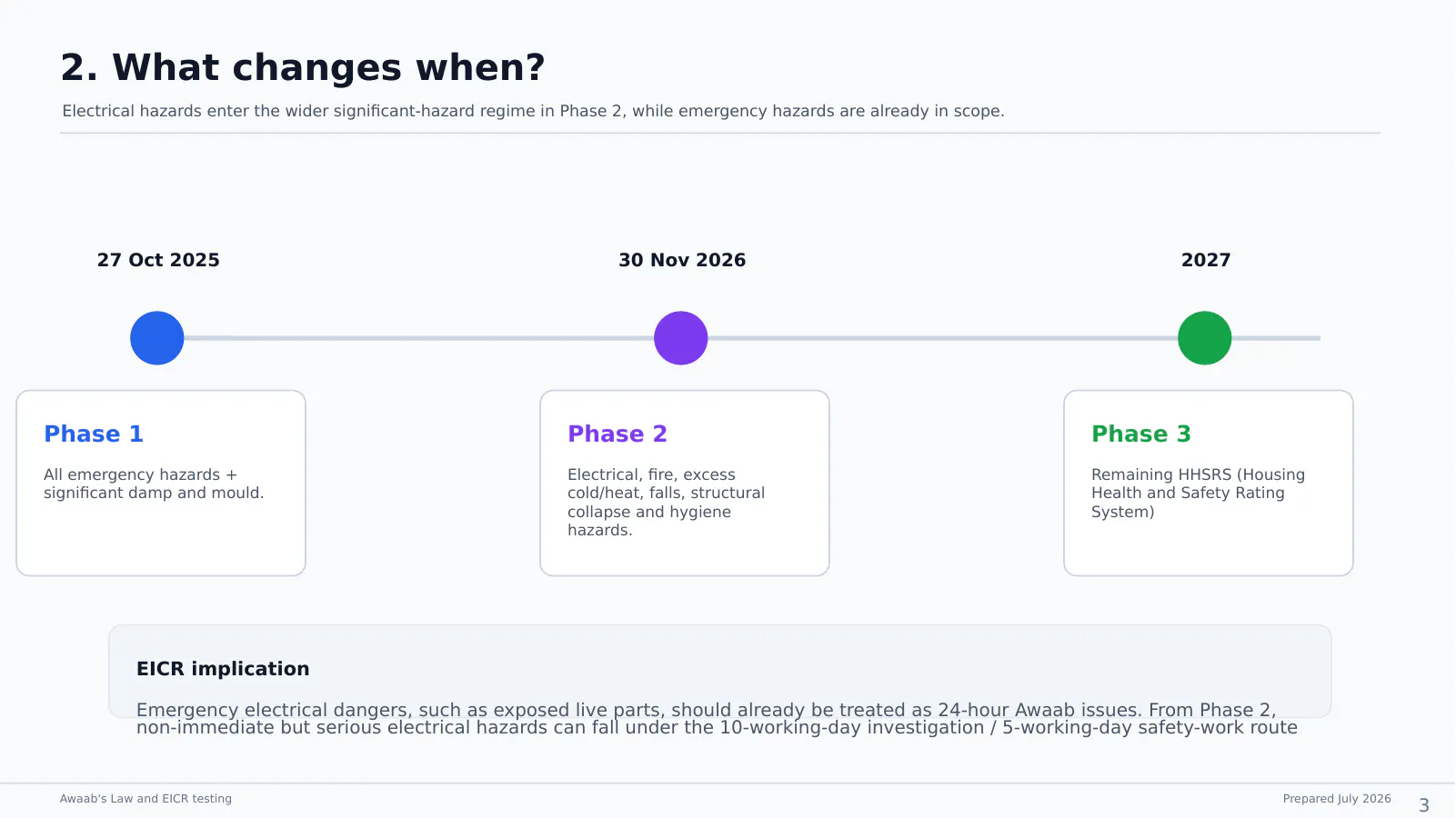
Emergency electrical dangers, such as exposed live parts, should already be treated as 24-hour Awaab issues. From Phase 2, serious but non-immediate electrical hazards fall under the 10-working-day investigation and 5-working-day safety-work route. The Phase 2 date is published, but the regulations are subject to Parliamentary approval, so keep an eye on that.
The EICR is evidence, not the decision
The EICR feeds the hazard decision but is not the whole of it. The route runs in four steps:
- Awareness. A tenant report, operative observation, EICR result or complaint creates "day zero".
- Electrical investigation. A suitably skilled or qualified electrician investigates where electrical risk is suspected.
- Classify and triage. Use the EICR codes, visible condition, access, fire overlap and resident circumstances.
- Make safe and prove it. Record temporary and permanent works, the tenant update, completion evidence and follow-on works.
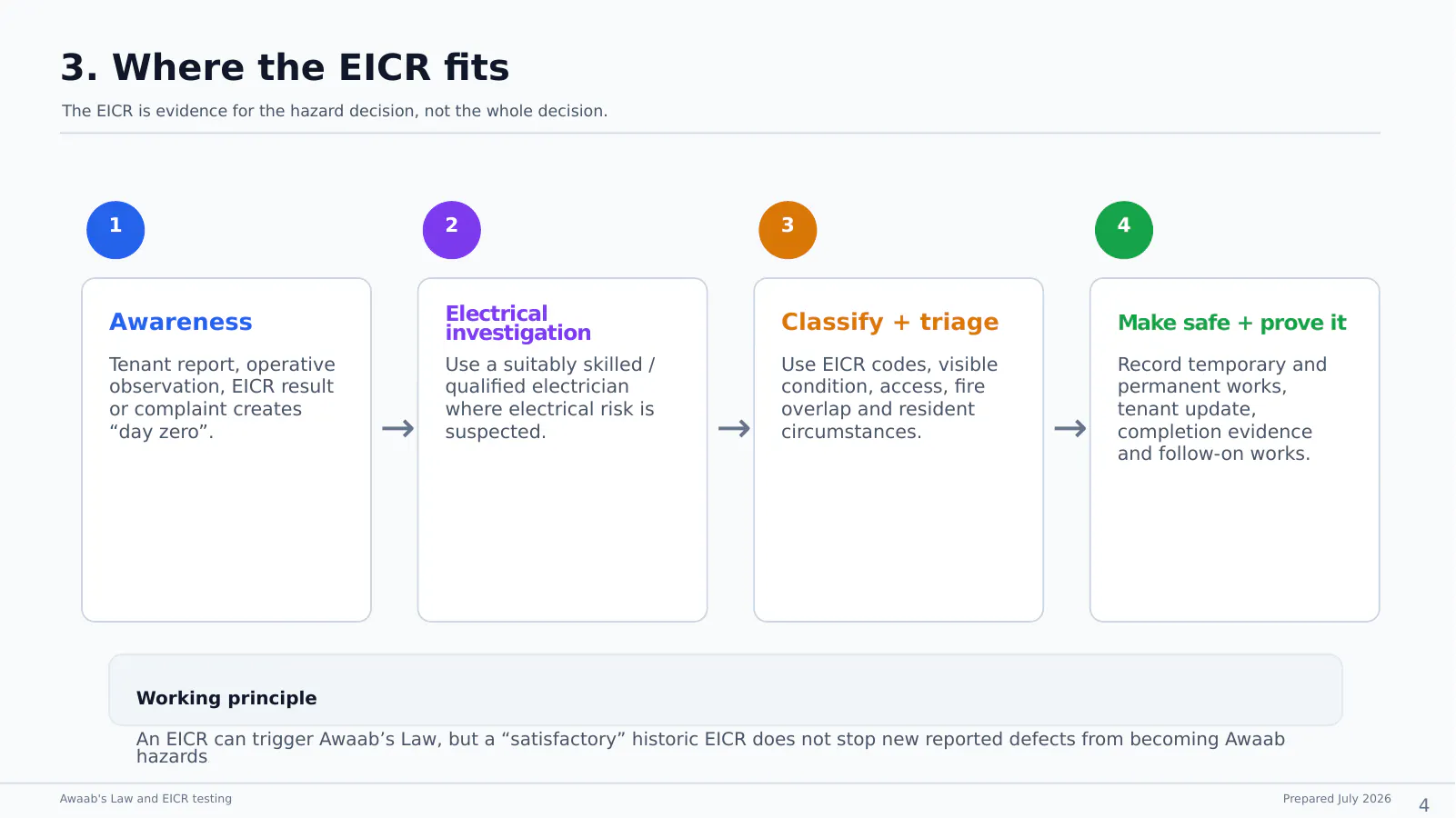
An EICR can trigger Awaab's Law. A "satisfactory" historic EICR does not stop new reported defects from becoming Awaab hazards. Issues arising between routine five-year inspections can fall in scope, so the repair-reporting process and the EICR programme have to talk to each other.
Mapping EICR codes to Awaab triage
Codes are inputs, not an automatic Awaab decision. The resident and the actual risk determine the category.
C1 (danger present; immediate remedial action)
- Awaab treatment: often an emergency hazard.
- Workflow: make safe immediately, and record the action and tenant safety advice.
C2 (potentially dangerous; urgent remedial action)
- Awaab treatment: may be significant or emergency, depending on immediacy.
- Workflow: fast-track repairs, and don't default to a 28-day window if the risk is higher.
FI (further investigation required)
- Awaab treatment: treat as a live uncertainty and investigate promptly.
- Workflow: escalate to a competent person, and track the outcome and any works.
C3 (improvement recommended)
- Awaab treatment: usually planned improvement, but vulnerability or context may bring it into scope.
- Workflow: triage case by case, and don't ignore tenant concerns.
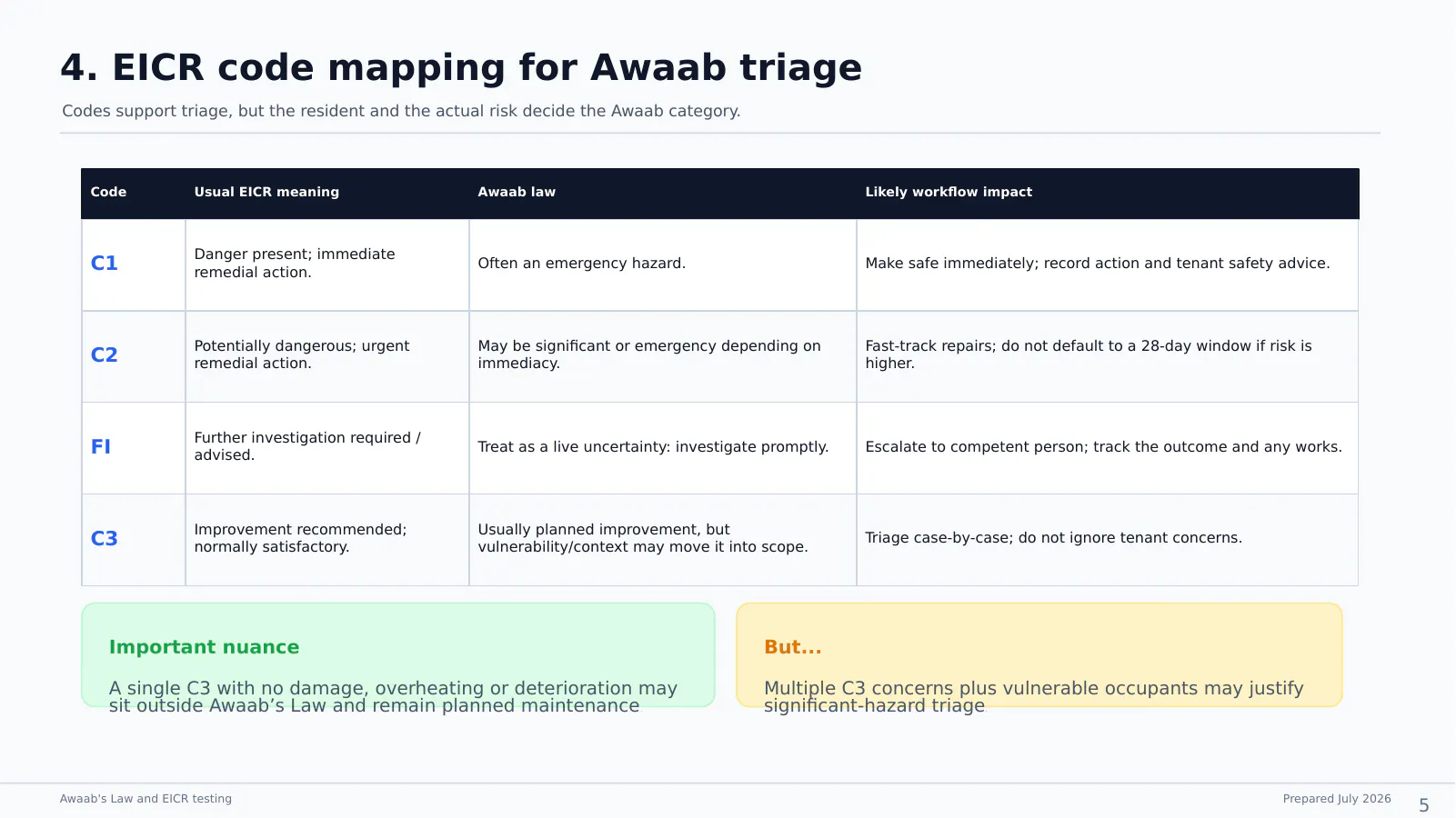
A single C3 with no damage, overheating or deterioration may sit outside Awaab's Law and remain planned maintenance. Multiple C3 concerns combined with vulnerable occupants may justify significant-hazard triage.
How the timeframes compress repairs
The biggest effect is faster triage and safety work, not more testing for its own sake.
- Emergency electrical hazards. Examples include exposed live conductors, damaged socket outlets, a clear shock risk or an immediate fire risk. Investigate and carry out safety work within 24 hours of becoming aware.
- Significant electrical hazards. These are deteriorated installations or deficiencies with potential for serious harm but no imminent danger. Investigate within 10 working days, then carry out safety work within 5 working days.
- Preventing recurrence. Supplementary preventative work must start or be initiated within 5 working days. Where initial steps cannot begin, physical work should start within 12 weeks.
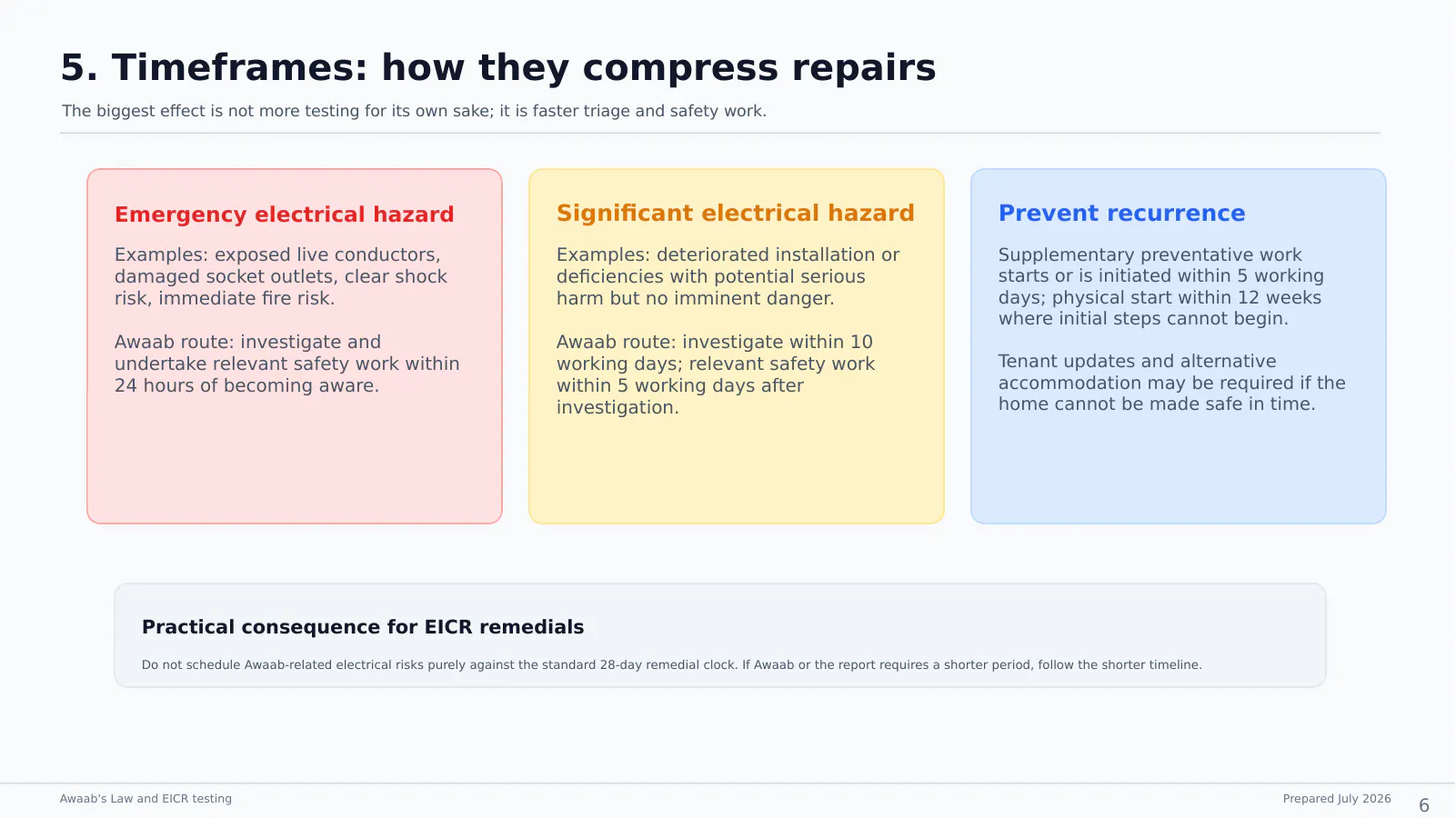
Tenant updates, and alternative accommodation if the home can't be made safe in time, may also be required.
Don't schedule Awaab-related electrical risks purely against the standard 28-day remedial clock. The 28-day period may still matter, but if Awaab's Law or the report itself requires a shorter period, follow the shorter one.
Changes to the EICR workflow
The operational change is integration. EICR, complaints, disrepair reports, resident records and repairs scheduling all need to line up.
- Pre-test. Know resident vulnerabilities where appropriate, access risks and any open repairs history.
- During testing. Make C1 safe immediately where possible and flag immediate risks to the landlord in real time.
- Report writing. Record location, risk, recommended action, urgency and whether further investigation is needed.
- Post-report handoff. Trigger Awaab triage, not just compliance tracking, and capture the date and time of awareness.
- Remedials. Separate temporary make-safe from permanent repair and supplementary prevention, and keep the tenant updated.
Readiness checklist before Phase 2
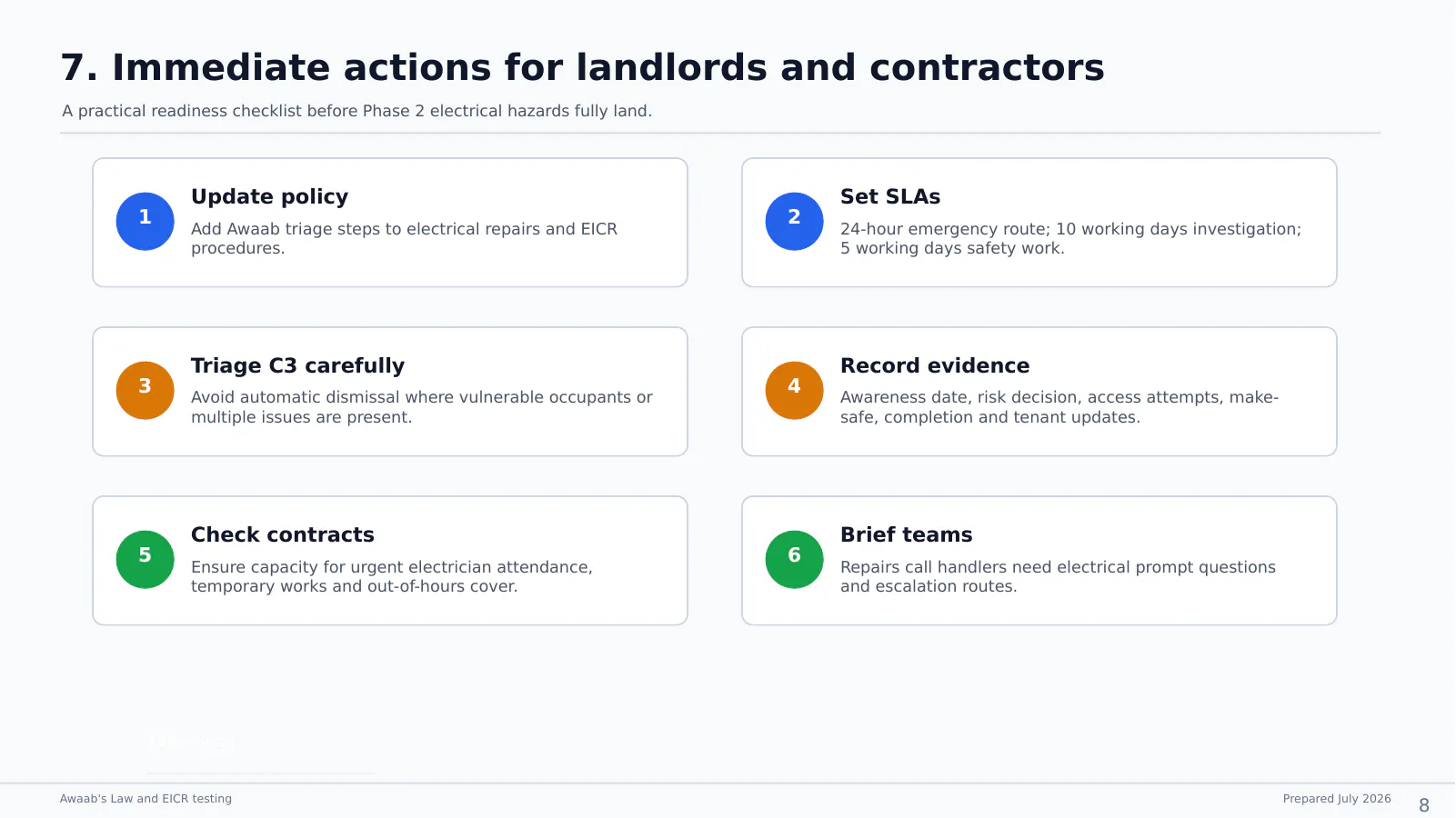
- Update policy. Add Awaab triage steps to electrical repairs and EICR procedures.
- Set SLAs. Use 24 hours for emergencies, 10 working days for investigation and 5 working days for safety work.
- Triage C3s carefully. Avoid automatic dismissal where vulnerable occupants or multiple issues are present.
- Record evidence. Capture the awareness date, risk decision, access attempts, make-safe, completion and tenant updates.
- Check contracts. Make sure you have capacity for urgent electrician attendance, temporary works and out-of-hours cover.
- Brief teams. Repairs call handlers need electrical prompt questions and escalation routes.
The takeaway
Awaab's Law makes EICR outcomes more time-sensitive and tenant-specific. The safest response is fast triage, fast make-safe, and good records.
Why this matters
Behind every process, timescale and piece of evidence is a resident and their home. Read Awaab’s Law: Turning Responsibility into Action for our perspective on why getting this right matters beyond compliance.


